The Quiet Season

With a decisive “click,” the glass of the storm windows locks into place, and the quiet season begins. The sounds of the outside world recede, muffled for the rest of the fall and winter, and I experience my usual mix of feelings at the start of this hushed time: peace and comfort in the relative silence of a warm home, a sense of loss with the passing of summer and fall, anticipation and resignation about the cold, gray winter ahead.

After growing up in Los Angeles, with its stunted sense of seasons, I appreciate the yearly cycle in the Great Lakes region, even though it can be hard. Winter is long and demanding. We sometimes have a week-long thaw in February, and eager faces turn toward the southern sky like sunflowers. Then the thaw ends. Winter returns. We scurry back indoors. When spring finally comes in earnest, I marvel at the bravery of snowdrops and crocuses and await the early-season tulips.

But long before the first buds of spring start to swell, winter turns us inward. Even by Halloween, a few cold, damp, blustery days have sent snowflakes or ice pellets sideways. Wind and hard rains hammer the colored leaves out of the trees, scattering them across lawns and walks and streets. We see neighbors less often; their children don’t play outside as much, and the street is no longer filled with their piping, excited voices. There are fewer spontaneous meetings on front lawns and porches. House lights glow through closed windows.

When winter weather comes to stay, all becomes quiet. Snow covers trees and bushes and earth. Walking outside, my boots crunch in it. The sound travels only a short distance before the snow sucks it into silence.

Indoors, sealed against the weather, we watch the darkness come early. The fire crackles. Cars whisper past. The sound of the traffic on the big cross-street a couple of blocks away, heard easily through summer windows, cannot penetrate the storm glass. It is as if the traffic has been diverted, though the cross-street remains one of the busiest thoroughfares in town.

Our lives settle into an indoor rhythm. The dog, burly and bear-like in his winter coat, spends more time curled up and snoozing. The two cats spoon like quotation marks. Flannel sheets go on the bed. Even they are quieter, rustling less than the smooth, cool, snappy sheets of summer. Soup burbles on the stove. The furnace hums to life, roars out its hot breath for a while, then sleeps again.

When I take the dog for his bedtime stroll, he sticks his nose deep in the snow, and I look up at the stars, waiting for him to be satisfied. A neighbor comes out of his house to rummage in his car. After he finds whatever he’s looking for, he straightens and notices me. We have known each other for a decade. In warmer months, we chat about yards and bikes and his retirement travels. Now, he only nods and hurries inside. His front door clicks shut, and I return to the stars. Orion hunts in the cold winter sky.
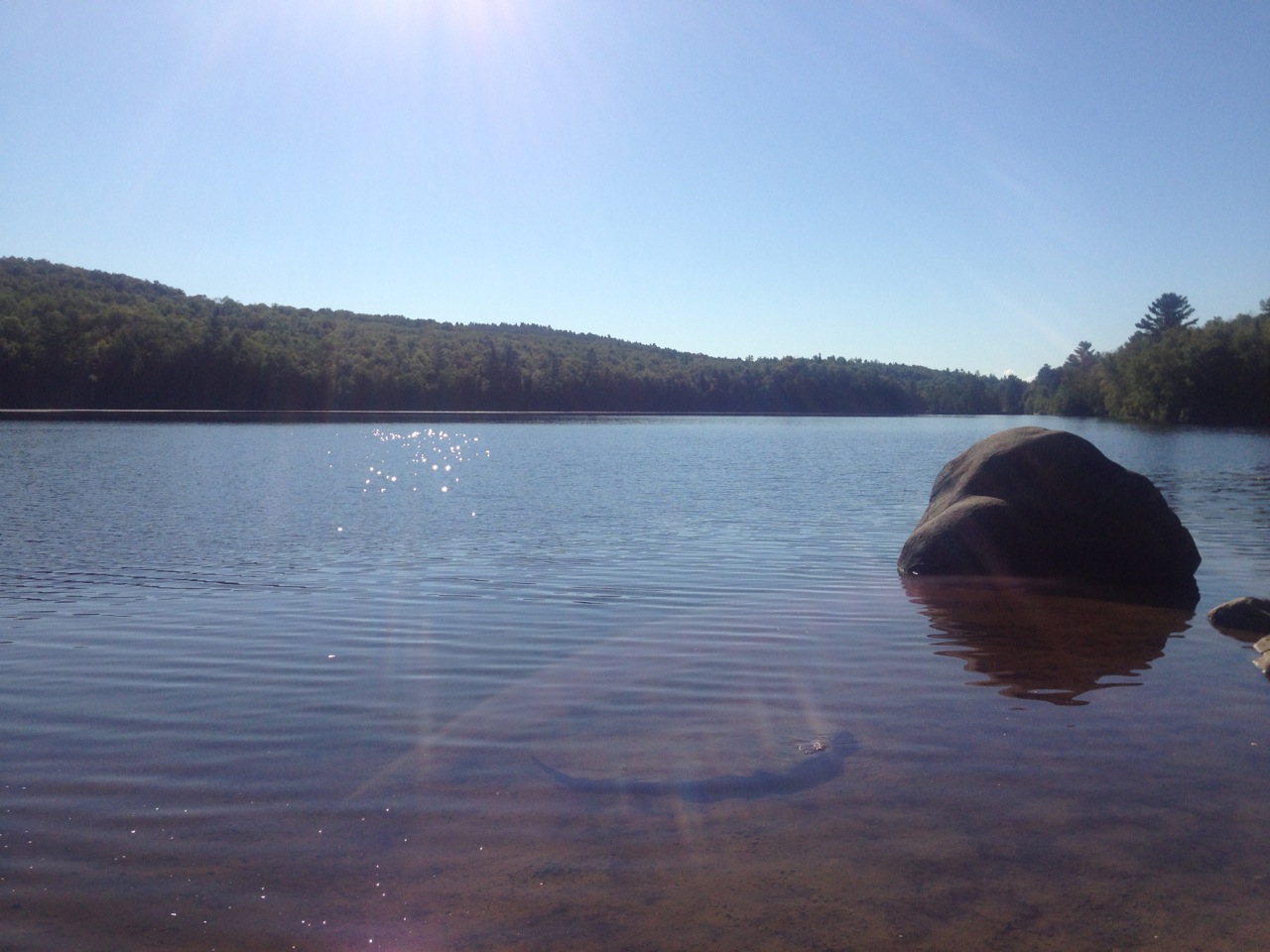
Ricker Pond reflections

Ricker Pond

Ricker Pond, Vermont / Joshua Kay

Sometimes sleeplessness is a good thing

To camp at Ricker Pond in Vermont, you need a good sleeping pad. The ground is stony, and you can’t clear the smallish cobbles.

So get a good pad. Join the talkative loons and numerous chattering brooks and wash of stars in the night sky. Breathe the Green Mountain air. Swim in the clear pond. Forget how hard you worked to get there. Don’t think about the days ahead in the next beautiful place. Just be fully present in this one. All that lies ahead will have its own time soon enough.

At Ricker Pond, I was reminded as my son slept next to me that young children travel in their sleep, as if their desire to explore doesn’t stop even when they’ve passed beyond wakefulness. That night, my 8 year old son shifted and turned, ending up by morning twisted in his sleeping bag. My wife and I remained squarely on our pads, as did our daughter, who is 11 and becoming less childlike by the week. The three of us looked orderly lined up in our parallel sleeping bags, while the boy finished the night with his legs across mine and his head in a corner of the tent. But he seemed to sleep well even as dawn came and the forest birds began to sing.

As usual on the first night of camping, I slept poorly, but I stopped minding that a few years ago. It gives me a chance to hear where I am. As all else goes quiet — my family, the campground, cars on a nearby road, my mind — the night sounds come alive. On Ricker Pond, the loons howled and laughed from dusk to dawn. Water rushed and trickled in the brooks. The wind whispered in the trees and rustled the fabric of our tent. Small animals scampered past. Nearly sleepless on the first night of camping, I was awake to my own wonder, at my most open and receptive, free to breathe and to listen.

A bunch of doctors: Just what the doctor ordered

Sometimes, as the Rolling Stones sang, you get what you need. And sometimes it is only when you get what you need that you realize just how badly you needed it.

This past weekend, most of my clinical psychology classmates – the entering Ph.D. class of 1994 at the University of Michigan – descended on Ann Arbor for a reunion. The only thing that would have made the weekend better was if the three who were missing had been there.

I have been blessed with a lot of laughter in my life, but seldom have I laughed so much as I did this weekend. At one point, when I was in my kitchen and everyone else was on the back deck, I just paused and listened to the laughter pouring through the open window. I felt such joy and satisfaction listening to that.

The night before all were to arrive, I was a bit worried. We had last been all together so long ago, I wondered if the chemistry wouldn’t be there. Would there be long, uncomfortable silences? Would we, a group that had been so close-knit in graduate school, find that we had drifted apart? It took no time after everyone’s arrival to realize that all was well. I mentioned to one of my classmates that I had had these concerns. He turned to me and said in his typically thoughtful, wise way, “Josh, how could it be any other way for a group of people who care so much about each other?” Notice that he said “care,” not “cared.”

These were my people, my dear friends, people I had spent a lot of wonderful and hard times with. We had gone through something intense and challenging together, and we had shared joy and sadness, devastating tragedy, complete triumphs, and a hell of a lot of laughter. We had picked each other up, dusted each other off, cheered each other on, challenged each other to feel and think more deeply, cried on each other’s shoulders, gotten each other out of scrapes, and supported each other through crises. We learned to be professional listeners together, and we listened a lot to each other. It is a remarkably healing and satisfying thing to be heard and feel known.

This weekend served as yet another recent reminder that I, once a practicing psychologist and now a lawyer, prefer the company of psychologists to that of lawyers. That’s not to say that all lawyers are bad company or that all psychologists are good. But as a general matter, there is a meanness that lurks just below the surface at best in law and a kindness that is readily apparent in psychology. Or perhaps I should be more direct: as a general matter, there is a meanness that comes all too easily to many lawyers and a kindness that is wonderfully accessible to psychologists. Even if you go into law to help people, sometimes the way that you have to help them is by being brutal and ruthless. I know too many people who describe that as “fun.” I’m fed up with them.

I am grateful to my psychology classmates for making the journey to Ann Arbor for our reunion. Those doctors were just what the doctor ordered.

Quiet

The view from Mt. Chocorua, New Hampshire

The view from Mt. Chocorua, New Hampshire

Nowadays, it seems to take an event to know what quiet really is – a power outage, a heavy snowfall, a journey deep into the woods, a climb to the top of a mountain… something decisive to silence the omnipresent hum in our lives. Without an event, we are surrounded by the whir of hard drives and computer fans, the whoosh of traffic on the busy cross-street, the breathy buzz of the dehumidifier in the basement, the hum of that reliable workhorse fridge motor, the blowing of central heating or air conditioning, the jawing of talking heads on television, the wail of sirens in the distance, the sharp hacking of a helicopter or roar of an airplane overhead.

Sometimes, it’s the presence of another sound that pulls you into consciousness of all of the sounds you’re not hearing. It might be spring peepers nearby or the sound of your favorite lake lapping against the dock you’re laying on or the alarm chirp of a cardinal or the thrum of rain on a still, misty mountain pond – at some point as you’re listening to these sounds, perhaps you think of all the sounds you’re not hearing, the sounds of our human industriousness and creature comforts and demanding, 24/7 media. The lack of those sounds lets you enjoy the gentler sounds around you.

What descends for me then is a sense of quiet. It occurs to me that this quiet isn’t really about the absence of sound but the absence of noise, and it’s certainly subjective. We all know it when we experience it, and we experience it under different conditions. I feel safe asserting, however, that different as we all are, most of us need this sense of peace, relative stillness, quietude, and many of us feel like we don’t experience it enough.

When I walked up a mountain a couple of years ago on my birthday, I was struck as I hiked up the trail by the near-total absence of people and their sounds. I heard nature and was fully in it, and to me, it seemed utterly quiet because it quieted my mind. There was motion – rushing water, rustling trees, scampering small animals, and my body moving through space – yet there was a remarkable sense of stillness that descended over me. This sense of quiet, of stillness, was accompanied by a feeling of timelessness. There was no hurry, no bustle, no concern about where I’d been or where I was heading. There was just each moment, passing into the next, and my presence in it. And there was absolute clarity that each moment was exactly what it was supposed to be.

Flag on a stick

Flag on a stickOne of my law clinic colleagues did mental illness commitment hearings in her first job out of law school. She once told me how these hearings would start: the parties and lawyers went into a room in the hospital psychiatric ward, and the judge came in, put a little flag on a stick on the table, and that made it a courtroom. All it took was a flag on a stick.

In the courts where I practice, there’s a big flag on a stick. A couple of them, actually. And a state seal on the wall. The bench is usually elevated and imposing; there’s a podium at which to address the court; there are a couple of counsel tables; there’s a clerk and a jury box and a witness stand. Everything has the trappings of court. It all says, “This is serious business. This is where your case will be heard. This is where justice happens.” But you know what? It’s often an unruly mess, and the consequences are devastating.

In child protection law, the legal authorities we rely on are all written down. There are statutes, and court rules, and case law, a fair amount of which applies constitutional principles to this important area of law. Most of these authorities are readily decipherable. You read the stuff, and it looks like this is a law-driven, rule-driven business with a deep respect for the Constitution, as it should in a nation that has an alleged devotion to the rule of law. Yet the reality is a morass of lawlessness, hunches, ends justifying the means, poor advocacy, and questionable decision-making. As a teacher in a legal clinic, it’s frankly a bit awkward to teach students all about the law only to have them experience general lawlessness and chaos when they try to apply it. My students can make wonderful legal arguments, but too often they lose because various people – including those in charge – don’t like the result that the law demands. Too often, good legal arguments are met with head-scratching, puzzled looks, emotion-driven retorts, derision, or worse, but seldom are they met with anything that would pass for legal counter-argument.

If the system’s players believe that the law is insufficient to meet the purpose of protecting children while not needlessly destroying families, then they should work to get the law changed. Ignoring the law or coming up with tortured, illogical pseudo-legal analyses to avoid applying the law is not a permissible solution. And if you’re tempted to say that trial courts sometimes make mistakes, but that’s what appellate courts are there to catch, then you need to know that even the simplest appeal often takes a year to play out. During that year, a child might be bouncing around the foster care system and a parent may be burdened with complying with so-called “services” that have little to do with any actual problems the family might have.

The child protection system is a mess, including the legal side of it, and this is the system that decides the fates of children and parents every day of every week of every year. It makes decisions by the thousands, and I’m afraid that a lot of the decisions are wrong, and a lot of those that are right got that way by accident.

In its place, I’d gladly take a little makeshift courtroom with a table-top flag on a stick if the advocacy was good, the judge listened, everyone got heard, the law was followed, and a fair decision was rendered. You can keep your shiny trappings. I’ll take quality instead.