On Black Rock Mountain

Trillium

Stretches of the Tennessee Rock Trail are steep as it climbs up and over Black Rock Mountain in Northern Georgia. The ribbon of deep brown soil is cross-hatched by exposed tree roots rubbed glossy by the soles of hikers’ shoes. It is spring, but brittle fallen leaves, silvered and curled with age, still litter the ground. The trail has the directness of other eastern trails I’ve hiked. There are few switchbacks. When it is time to go up, it just goes up.

The damp air, scented with moist earth and wet stone, hangs about the mountain’s flanks and drapes itself across our shoulders like a friendly arm. Clouds stretch northward in varied shades of gray, diffusing the light into an indistinct wash. Looking out at the vast, layered jumble of the Blue Ridge Mountains, I am reminded of how ancient the Appalachians are. They are weathered, lumpy rather than jagged, rounded by time. In the distance lay the Smokies, nestled in the mists, beckoning.

The trail crosses the Eastern Continental Divide, which is marked by a large sign. The children and I straddle the line, grinning, as if each of our feet is now pulled in a different direction like the rivers of the region. On one side, streams run to the Mississippi and then to the Gulf of Mexico. On the other, water flows to the Savannah River and the Atlantic. The elevation here is about 3,600 feet, high for Georgia.

As we hike, we catch a quick glimpse of the road just beyond a section of wooden fence on which hangs a large sign that commands us to “Stay on Trial.” The road itself is a reasonably unobtrusive strip of asphalt that shows some age, fine cracks running through it like lines on a weathered face. The trail takes us right up to the fence, then turns abruptly away to head back across the mountain, back into the woods. The road recedes in space and in our minds. I notice no noise from it. Whether that is due to the lack of traffic or the sound being blocked by the humped ridges of the mountain, I cannot say.

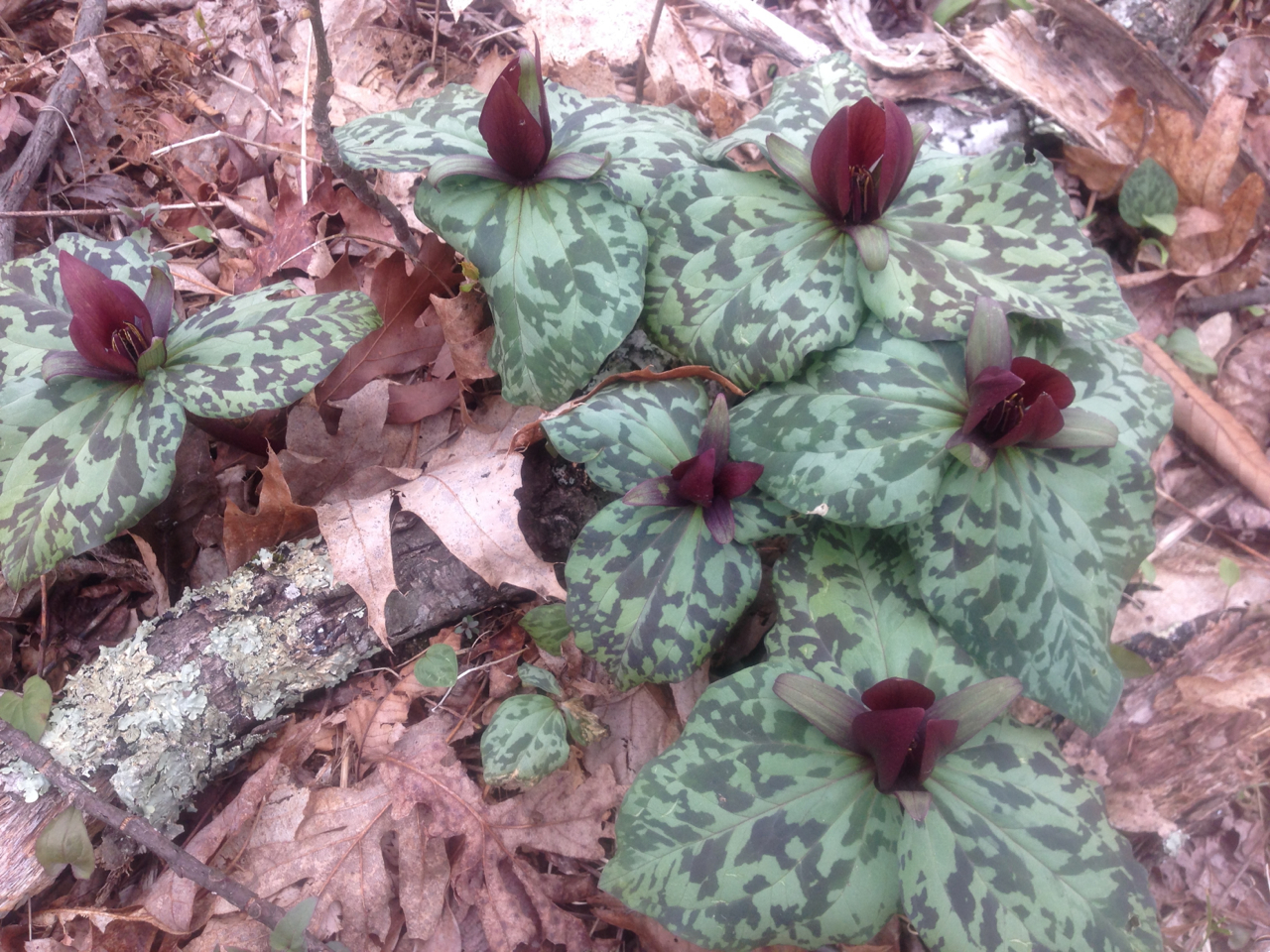
Throughout the hike, I am amazed at how much trillium there is. They are unlike any I have known. The flowers are a rich, deep red, like port wine, surrounded by three small leaves of green blushed with red, which are in turn set upon a base of large, variegated leaves marked by patches of dark and light green. The trillium are often joined by bloodroot, their funny, hand-like leaves waving in the breeze, some of the bobbing stalks topped with open, white flowers, others with swollen buds.

A multigenerational family hike moves along at varied paces. The children race ahead, then return, like spiders leaving the web on threads and pulling themselves back again. On some of their forays, they perch on large, rough boulders, taking pride in scrambling up the rocks and leaping down again. We hang back from them, letting them have their space, their chance to explore without the feel of watchful eyes. My wife and her folks and I walk most of the time in an extended line, my wife and I mindful of the children ahead and their grandparents behind. We all join together and chat happily at some times and are separate and silent at others, enjoying the sounds of the wind and our shoes crunching on the path and the fresh, spring leaves rustling and twisting.

On this cool, damp day on the trail, it is just our little party and the birds, which twitter on the mountainside and dance on tree branches. After the first short stretch of the hike, we do not see another soul.

Emergence: A Spring Appreciation

spring shootsMarch passed in its typical, indecisive style. Though the Michigan winter loosened its grip, it also clamped back down every couple of days, a rough reminder that it could still send us diving under our blankets.

Yet when the sun was high in the sky, it was no longer a teasing, distant disk that offered light but no heat. Now we could feel it. As March went on, much of our record snowfall melted away. We opened our jackets and welcomed the sunlight against our pale skin. Pond-sized puddles formed on sidewalks and along curbs. Most nights, they froze hard and slick.

April has started with the promise of a consistent run of above-freezing highs. After the winter we’ve had, it’s no surprise that a 45-degree day feels balmy. I was happy to tuck my parka into the closet in favor of a light jacket.

We wince at enormous potholes, swerving our cars to avoid them if traffic permits. My son says it’s like the giant slalom in the Olympics. And when you’ve got no choice but to hit one of these craters, trouble follows. Crumpled hubcaps decorate the curbs of our busiest routes, and tire stores are having a banner spring.

Filthy, icy piles of snow remain, like tiny glaciers, layered and compacted and full of grit. My driveway is clear now, but there were three inches of ice there for months, four or five at the base of the curb cut. Hacking it out made my shoulders burn.

As we clean up, sweeping away winter’s mess and turning our faces to the sun with relieved appreciation, we search our garden for signs of life. There’s not much there yet, but this morning, as I set out for work, thin crocus leaves greeted me, barely peeking from their pale sheaths.

Spinning the Cranks

Cycling through the natural world

A short, smooth stretch of what is otherwise a poorly paved road allowed me a break from watching for ruts and potholes. I biked under a clear, deep blue sky, and the trees wore the rich, darkening green of summer. Frantic cawing drew my eyes up to my right, and I saw three shining crows wheeling wildly through the air above a tree. Then I saw the raptor. It beat and spread its powerful wings, accelerating and slowing, rising and falling, squared off in a duel against the crows. I could not tell as I passed whether the crows were trying to force the raptor into the huge evergreen or working to chase the bigger bird away from it. I also couldn’t tell what sort of raptor it was, thanks to its frenetic dance with the crows and the glare of sunlight against its feathers as I rode by. Elijah would know, I mused, thinking about my nine-year-old son, who loves birds of prey above most things.

As I rode on, I thought about the fact that had I been in a car, I would have missed seeing the arial duel. I had heard that these things happened from time to time but had never seen for myself. And though I would not have known that I had missed anything if I had zipped by in a car — radio on, windows up and shutting out the world or down so that the roar of the wind drowned all other sound — I felt a pang of regret for all that I must miss as I drive.

Pausing on a dirt road ride / Joshua Kay

Pausing on a dirt road ride / Joshua Kay

Once, on a night ride with friends along the wonderful network of dirt roads just outside of town, we were spread side by side and chatting amiably under the moonlight when our voices were drowned out by spring peepers trilling in a wetland, unseen in the dark. We fell quiet, overwhelmed and mesmerized by the mighty sound of the tiny frogs. As we passed, I thought to myself, “This is why we ride our bikes out here at night.” A few minutes later, my friends took off on one of their traditional sprints to the next “stop ahead” sign. I didn’t join this one; I’m no sprinter, and I knew I would catch up to them anyway as they slowed and panted and laughed. Then we’d ride on together again under the moon and stars. I have driven that stretch of road in that season at night. From a car, I have never heard the singing of the frogs.

On Huron River Drive, which undulates and twists alongside its namesake northwest of town and provides our best road cycling, I can smell the river and wet stones, a mineral, almost metallic, smell. The tires are quiet on the pavement. If I’m going hard, then my mind is focused only on maintaining the effort and keeping my form. Pull up on the pedals, kick over the top, power through the downstroke, “scrape” the sole of your shoe through the bottom before pulling up again. Minimize upper body movement. Stay loose. When I’m spinning easy, my mind is calm with the rhythm of the pedaling: tick tick tick tick. Either way, I feel untroubled. In the breeze, hearing the sounds around me, breathing the air, inhaling the moist, earthy smells, and seeing the shining, wide river, I feel close to nature.

Riding along one stretch of the river road on a particularly mild, early spring day, I saw a broad cluster of purple crocuses tucked in the new, bright green grass in the roadside ditch. The violet beauties threw open their petals to the sun, their bright orange stamens glowing in the light. Had I not been on my bike, they would have remained hidden to me, a swath of beauty unseen in a ditch. I slowed to admire them. It was as if they were standing in formation and saluting all who would notice. Cars raced past.

Bikes are quiet. Riding the road, I sometimes inadvertently glide up to deer, and though they do depart when they finally notice me, it is with a nonchalance that suggests that they feel unthreatened. I have seen a cluster of wild turkeys skulking in the tall grass, lanky and lean and saurian, their sharp eyes glinting and scaly heads bobbing and twitching as I passed. There are wildflowers and weeping willows, small creeks flowing fast into the river, long-dead trees lying jagged and half-submerged, and just a small ribbon of road winding alongside. Riding on it, all of the sights and sounds and smells are accessible to me.

River roads are often beautiful. There is so much life along a reasonably well-preserved river, and the natural curves of the waterway and the roll of its surrounding land make for good riding. They make for good driving, too. There is a sign along our river road to notify drivers that it is a scenic route. Scenic though it is from a car, many of those drivers have no idea.

Ricker Pond reflections

Ricker Pond

Ricker Pond, Vermont / Joshua Kay

Sometimes sleeplessness is a good thing

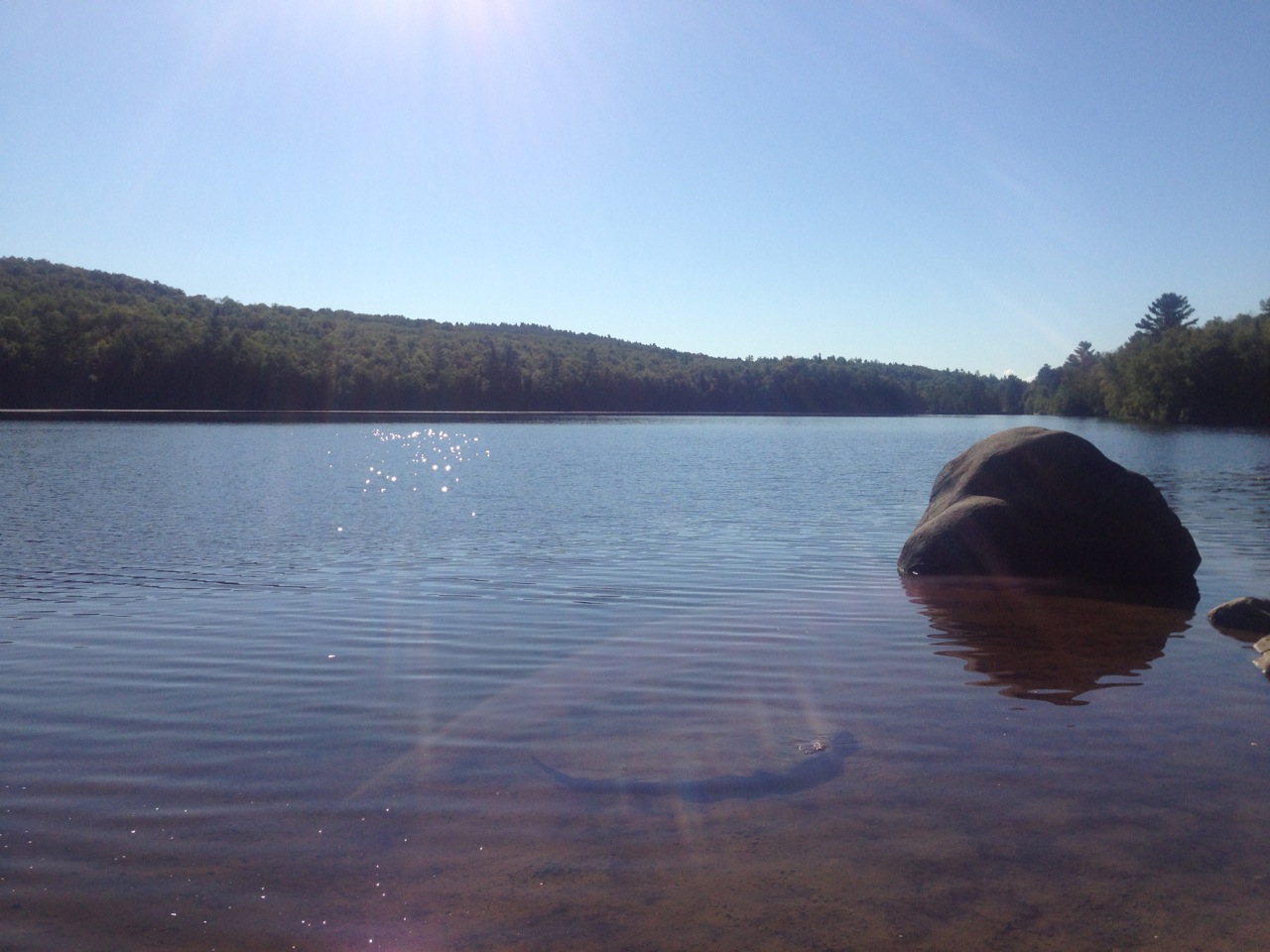
To camp at Ricker Pond in Vermont, you need a good sleeping pad. The ground is stony, and you can’t clear the smallish cobbles.

So get a good pad. Join the talkative loons and numerous chattering brooks and wash of stars in the night sky. Breathe the Green Mountain air. Swim in the clear pond. Forget how hard you worked to get there. Don’t think about the days ahead in the next beautiful place. Just be fully present in this one. All that lies ahead will have its own time soon enough.

At Ricker Pond, I was reminded as my son slept next to me that young children travel in their sleep, as if their desire to explore doesn’t stop even when they’ve passed beyond wakefulness. That night, my 8 year old son shifted and turned, ending up by morning twisted in his sleeping bag. My wife and I remained squarely on our pads, as did our daughter, who is 11 and becoming less childlike by the week. The three of us looked orderly lined up in our parallel sleeping bags, while the boy finished the night with his legs across mine and his head in a corner of the tent. But he seemed to sleep well even as dawn came and the forest birds began to sing.

As usual on the first night of camping, I slept poorly, but I stopped minding that a few years ago. It gives me a chance to hear where I am. As all else goes quiet — my family, the campground, cars on a nearby road, my mind — the night sounds come alive. On Ricker Pond, the loons howled and laughed from dusk to dawn. Water rushed and trickled in the brooks. The wind whispered in the trees and rustled the fabric of our tent. Small animals scampered past. Nearly sleepless on the first night of camping, I was awake to my own wonder, at my most open and receptive, free to breathe and to listen.

Quiet

The view from Mt. Chocorua, New Hampshire

The view from Mt. Chocorua, New Hampshire

Nowadays, it seems to take an event to know what quiet really is – a power outage, a heavy snowfall, a journey deep into the woods, a climb to the top of a mountain… something decisive to silence the omnipresent hum in our lives. Without an event, we are surrounded by the whir of hard drives and computer fans, the whoosh of traffic on the busy cross-street, the breathy buzz of the dehumidifier in the basement, the hum of that reliable workhorse fridge motor, the blowing of central heating or air conditioning, the jawing of talking heads on television, the wail of sirens in the distance, the sharp hacking of a helicopter or roar of an airplane overhead.

Sometimes, it’s the presence of another sound that pulls you into consciousness of all of the sounds you’re not hearing. It might be spring peepers nearby or the sound of your favorite lake lapping against the dock you’re laying on or the alarm chirp of a cardinal or the thrum of rain on a still, misty mountain pond – at some point as you’re listening to these sounds, perhaps you think of all the sounds you’re not hearing, the sounds of our human industriousness and creature comforts and demanding, 24/7 media. The lack of those sounds lets you enjoy the gentler sounds around you.

What descends for me then is a sense of quiet. It occurs to me that this quiet isn’t really about the absence of sound but the absence of noise, and it’s certainly subjective. We all know it when we experience it, and we experience it under different conditions. I feel safe asserting, however, that different as we all are, most of us need this sense of peace, relative stillness, quietude, and many of us feel like we don’t experience it enough.

When I walked up a mountain a couple of years ago on my birthday, I was struck as I hiked up the trail by the near-total absence of people and their sounds. I heard nature and was fully in it, and to me, it seemed utterly quiet because it quieted my mind. There was motion – rushing water, rustling trees, scampering small animals, and my body moving through space – yet there was a remarkable sense of stillness that descended over me. This sense of quiet, of stillness, was accompanied by a feeling of timelessness. There was no hurry, no bustle, no concern about where I’d been or where I was heading. There was just each moment, passing into the next, and my presence in it. And there was absolute clarity that each moment was exactly what it was supposed to be.