Dry spells

A dry spell in writing makes you feel oddly empty and full at the same time. Empty in the sense that you feel like there’s just nothing in you to write down. Full in the sense that you feel bloated and clogged, full of scraps of writing, little bits here and there, fits and starts, but nothing that will come to fruition. It all just backs up and remains unsatisfying. In the long dry spell that I’ve had since this past winter, I’ve started several blog posts. Some got to full length, nearly complete, yet with every single one, I’ve decided that it wasn’t good enough to post. Each failed to capture what I meant to say, and each went straight into the bin. Perhaps one or more will get resurrected at some point when I figure out how to change it in just the right way.

Winter, which was real and long this year unlike last, gave way to a rainy spring, and as is common here in Ann Arbor, spring has suddenly tripped into summer. The semester ended, I said goodbye to my students, welcomed summer interns to the clinic, and got them up and running on cases. My case load is smaller than it’s been in nearly five years, thanks to some well-timed case closures, and I have an opportunity to get some academic research and writing done. I’m glad about that, yet I’ve worried that my writing energies will be taken up by academic papers, leaving nothing for other writing efforts. Today, though, I realized that writing feeds more writing. It doesn’t have to be the case that in doing my academic work, I’ll somehow drain the reservoir. When I was working regularly on The Hopping Mind for a couple of months before the winter blahs set in – and in looking back, I think that’s exactly what happened – I found myself more productive at work as well. Writing at home and writing at work complemented each other and set the juices flowing. The Canadian author Robertson Davies was a full-time journalist for much of his life, all the while writing prolifically outside of work, and he noted how each energized the other.

While I don’t have much interest in “how to” books about writing, their authors generally maintain that if you want to write, just keep doing it regularly. It’s a process that feeds itself.

They make a good point.

Happy industry

photoIt’s time for me to take a shower, so I tell my 8-year-old I’m heading upstairs. He says he’s going to stay downstairs at the little table he shares with his sister by the big sunny window, the table where they do art project after art project. He’s going to draw.

I climb the stairs and, before I shower, I check my email and get tangled up in some work-related stuff. As I’m trying to muddle through a problem, sending off emails and double-checking case notes, I hear whistling from downstairs. Sometimes tuneless, sometimes melodic, always cheery, it’s the sound of a child doing what children love to do most: being creative, making something, exploring the space between his own imagination and the world around, his discoveries reflected in what he puts on the page. I can hear my son drawing away happily, his cheerful bird call signaling to the world that he is drawing at the table by the sunny window and loving the moment. It’s the sound of happy industry.

My son and daughter are very different kids. My son wears contentment on his sleeve, humming and singing and whistling while drawing or painting or reading or building or even eating. Yes, he hums when he is eating something that he really loves – nice feedback for the cook. My daughter shows her contentment differently, by channeling her natural intensity into an activity, be it art or reading or writing or pretending. She just goes deeply into whatever it is, and it’s her involvement and concentration that tell me that she’s truly happy.

Both of my kids seem happiest when they are creating. Children love to make stuff. They are industrious. It’s not the adult version of productivity, which is so often marred by anxiety and pressure, banality, repetition, performance metrics and high-stakes outcomes. Instead, children pursue happy industry. They eagerly seek ways to interact with the world in a fully active, engaged manner. They turn a box into something to play with; create a small book of drawings; glue together sticks to make a little house; fall into a great book; play school with stuffed animals or dolls; create entire imaginary worlds – it’s all about making something, transforming one thing into something else, learning and engaging, pretending, being active, not passive. A great deal of what they do most naturally is inherently creative. When their version of productivity is devalued and forced to look more like that of adults – e.g., with an over-reliance on performance metrics, high-stakes outcomes (i.e., testing), repetition, banality, pressure – we are getting in the way of their healthy development.

The trailblazing psychologist Erik Erikson conceptualized psychosocial development as a set of stages, each stage framed as a conflict between a healthy developmental step and what happens if that stage is not completed successfully. His theory, unlike other psychoanalytic theories of the day, extended the concept of development across the lifespan and was concrete about what people are trying to accomplish at each stage. The fourth stage of psychosocial development, from ages 5 to 11, he called “Industry vs. Inferiority.” Healthy development in this stage is marked by increasing pride in one’s accomplishments, active engagement with the world around oneself, and a blossoming sense of oneself as competent. In college and graduate school, studying child psychology, I was particularly taken with the sense that children are industrious, and their form of industry is fun and creative and both inspiring and humbling to see.

Historic site: former fort

Historic site: former fort

Under the evergreen tree in the front yard, shadows move in the twilight. My kids and two friends are building a fort out of logs. They move about, staying low under the boughs, pausing and squatting and placing logs, spider-walking around their developing creation. Walls take shape; conflicts and compromises get worked out; gravity is reckoned with when some logs topple and have to be placed carefully anew. Plans are laid, attempted, and reworked. Their discussions are barely audible through the house window. My son occasionally whistles. I’m aware of all of these sounds as the hum of contented kids doing what kids love to do most – it’s the hum of happy industry.

Most days, I would like to walk up a mountain

On the summer day that I hiked it, there were a lot of people at the top of Mt. Chocorua in the Sandwich Range of the White Mountains. I was surprised to see them, because I didn’t hear them from down below, even as I neared the summit. The entire way up the mountain, I had seen a tiny handful of people, yet here were much more than a handful. Most had come up the trail on the other side, and though I knew the mountain was popular, I had no idea that I’d end up among so many people. Groups, some quite large, were sitting all over the boulder-strewn top. A few dogs cavorted among them, showing off their four-wheel-drive agility on the rocks. Despite my surprise and even disappointment at seeing so much humanity so suddenly after such a quiet hike, I also felt the companionability common to hikers. As I reached the top, several nodded and greeted me. I spent a few minutes wandering the mountaintop, making sure to tap my toe on the U.S. Geological Survey summit marker, and eventually settled on a spot facing the Presidential Range to eat my lunch.
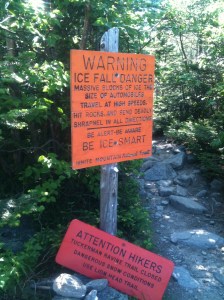
Winter-related hazards can await in Tuckerman Ravine, even in late June.

Winter-related hazards can await in Tuckerman Ravine, even in late June.

Mt. Washington’s broad shoulders were visible, though the peak was lost in gray clouds. In a line from Mt. Washington, I thought I could make out Mt. Monroe’s asymmetrical peak and Mt. Eisenhower’s domed pate, and I thought about standing atop each just over a month earlier. The White Mountains of New Hampshire are beautiful and rugged and unpredictable. Though they lack the altitude of the Sierras, Cascades, or Rockies, I sometimes describe them the way I describe certain basketball players: they play taller than their height. They spring from fairly low-lying surroundings, making for plenty of elevation gain. And they sit at a spot where significant weather patterns converge. Dangerously high winds are possible on the ridges and peaks, particularly in the Presidential Range; even when not dangerous, the wind is almost always strong. Clouds can roll in and descend in an instant, taking visibility down to nearly nothing and making you grateful that the high-elevation trails are marked by huge cairns. Those clouds can chill you to the bone, and sudden snowstorms have occurred even in the summer months. Hypothermia is a constant threat. The tree line dips below 4,000 feet. Jutting upward to meet the wind and storms, the mountains help make the weather, and the weather, in turn, remakes the mountains.

Experiencing the Whites is about the weather and so much more. The hikes up to the peaks and ridges run through beautiful forests and along swift streams before bursting above tree line into fields of boulders. On the ridges that run between the peaks, the views on either side stretch out before you in a magnificent quilt of rocks and trees that runs to the next set of mountains. Nestled below the shoulders of Mt. Washington are two vast, steep bowls: Tuckerman Ravine and Huntington Ravine. Curved and oriented perfectly to capture winter storms, Tuckerman develops a tremendous snowpack during the winter, and the trail up the headwall doesn’t open until approximately midsummer. Huntington is steeper, harsher, riven and jagged. The hike up it is considered one of the most challenging in the Whites; hiking down is too difficult and dangerous for most. Roughly between the two ravines runs a trail through the Alpine Garden, a rocky meadow of sedges marked by a variety of alpine flowers, the likes of which I’ve only seen at much higher altitudes in the Sierras, Cascades, and Rockies.

Tuckerman Ravine from the ranger station near its base.

Tuckerman Ravine from the ranger station near its base.

The trails up to the ridges and peaks of the Whites have very few switchbacks. They just go up, which sounds practical enough when I write it here but can feel kind of insane when you’re actually hiking. When I was in high school in Los Angeles, where we were perhaps a little too “blessed” by interesting geological features and events, one of my best friends and I frequently went hiking in the Santa Monica Mountains. The Santa Monicas run right to the sea, and parts of them – even near the city – are remote enough that you can lose yourself in them. That’s all we wanted to do. One of our favorite hikes started on the Chumash Trail, an old Chumash Indian route that shot straight up to a ridge from the coast on a thin ribbon of soil through low brush and prickly pear. No switchbacks. Trails in the Whites are like that, too, but longer and far rockier. On the Chumash, I was always surprised to turn around after just a little while, quads and calves burning, and see that the car already looked tiny far below next to the grey of the Pacific Coast Highway, the yellow sand, and the sparkling ocean. In the Whites, the surprise comes as you suddenly emerge above tree line into the alpine domain, and you turn and take in a view that makes you wonder why you hadn’t done all of this sooner.

Most days, I would like to walk up a mountain. That feeling started for me in Yosemite National Park and the Mammoth Lakes region of the Sierras, and it continued in the Santa Monicas and Lassen Volcanic National Park and the Cascades and the Rockies. The Whites have found a place in my heart, too, even though my experience of them is limited to just a couple of trips. I plan to take many more over the years, including this summer.

It is rare for a day to go by without me thinking about how nice it would be to be heading upward.
Closing 2012 in the Georgia mountains

My in-laws’ roof is pounded tin, painted rust-colored, rippled and folded where the panels connect. The rain of the north Georgia mountains swooshes and swats on it, tapping a rhythm that backs the wind’s high drone around the peaks and eaves of the roof. A storm sounds like popping corn – first pops tentative and irregular, then the squall of pops so rapid that it gets hard to distinguish among them, then slowing again, rap… rap rap… rap… rap… into silence.

Over the triple-peaked mountain visible across their property – stand on the wrap-around porch and look down the slope of the lawn, past the split rail fence and gravel drive, across the pond, then beyond the neighbor’s orchards and the expanse of land after the town road to the mountain, whose very base is just about visible in the winter – the changing clouds tell the story of the verdure of this slice of the country as they bring wetness in all its forms. Giant black thunder-heads in the summer, the high, light gray of a steady spring rain, the dark enveloping gray of a winter storm, the humps of the peaks disappearing one by one in the lowering mist, the world obscured.

Cocks crow nearby. Cattle bellow over at another farm. A coyote once peeked in slyly through the low windows of the former back porch converted into an art studio where my mother-in-law paints. The dog can’t be let out alone at night. Life is everywhere.

Image

Just after Christmas, an old friend of my wife came up from Atlanta to see us, and we took a walk on a path that my father-in-law cut. He has created shrines along that path, little places of memory and reflection placed every so often to remind him of people and moments past and present. His children and grandchildren are in those places. Friends abound. Rocks and plants are placed just so, and there are several bird houses. My in-laws are great lovers of bird houses. Everywhere there is life. Small birds flit from branch to branch, twittering. A hawk or falcon – the glare of the sun and my eyesight conspire to rob me of any chance of identification – banks over the orchard. Farther away, several turkey vultures circle, keen observers of impending death. I turn away from them, back to the explosion of life nearer at hand. Soft, furry moss spreads over hummocks of reddish earth. Some sort of clubmoss with little trident-shaped sprouts bobs and nods in Seussian style, with contrasting dark vinca nestled underneath and all around. Grasses sprout in tufts. Trees are everywhere, and rhododendrons provide pockets of shade.

Where there is so much life, there must be water, and indeed a creek winds through, flowing and trickling down the hillside and underneath wooden bridges greened slick by moss. Scaly, grey-green nets of lichen give texture to tree trunks and stones. The air smells wet and like old plants leaving life behind and new ones gaining strength. Wet stone throws off mineral scents and I wonder if that’s what wine lovers are referring to when they use the term “mineral” in their tasting notes. If you looked at the creek water under a microscope, you would see a whole living, respiring world that is no less busy and alive and simultaneously symbiotic and competitive than the visible one all along the path. Everywhere are birth and death and the in-between thing that we hang on to as long as we can.

I walk the path along the creek, the water burbling softly. Here and there, the water disappears for a few meters below ground, then springs back into the open to sing and shimmer again. It has carved a small canyon for itself, and the path follows the ridge above. Past the wooden bridge that connects the path on this side with the portion on the other, and past one more shrine – this one has the look of a small labyrinth in stones, and the way some are sinking into the soft earth makes it look ancient and mysterious – the path terminates at an ordinary wire fence. The property line, abrupt and angular. The creek bed winds beyond, but the wild woods quickly peter out. There is a house with a regular lawn, then a few buildings and the old highway leading into town. I stand at the fence and follow the small gash of the creek bed with my eyes. I can’t see where it runs past the buildings. The land rises on the other side of the highway, and I guess that somewhere up there is the origin of the creek. I want to see it, the spot where water perhaps flows right out of the earth itself and starts something that goes on to nourish so much life down below.

ImageI go back to the bridge and cross it to the path on the other side. More moss and trees, more memorials, more birdhouses. Some copper and tin figurines, variously tarnished bright green and rust red. I come out of the woods, and the vultures are gone from the sky. I think that if I were to walk into the orchard or a bit beyond, I would find them at their meal.

A bialy and coffee and…

It started with a bialy. Crust Bakery, a terrific bakery in Fenton, has bialys. When I first saw that in a Facebook post, suddenly in my mind I was with my grandmother in her Chicago apartment, munching contentedly on an onion bialy with cream cheese and sipping orange juice with the Tribune spread around the table. The lake is beautiful out the east-facing windows, and I’m with one of my favorite people in all the world. Her smile comes easily, and hers is a smile that is complete and genuine, her eyes curved into gleeful little half-moons.

From there, it’s just a short trip further into the past and my grandfather has joined us. In fact, I’m up extra early with him, grandma still sleeping. The sun is coming up over the lake, and I’m drinking coffee. I’m awfully young for that, but it’s about half milk, and it tastes creamy and bittersweet with a teaspoon of sugar in it. And always, there’s the Tribune on the table. I’m looking at comics and sports, my grandfather at the news and opinion and business sections. He gets the sports after awhile, too. I’m most interested in how the Dodgers are doing, me being an LA boy, and one of these visits to Chicago is made extra special when my grandfather takes me to a Cubs-Dodgers game. It’s a sunny day, warm but not too humid. We walk block after block west on Addison to Wrigley. It’s one of the great days of my childhood, me dangerously wearing my Dodgers cap in enemy territory, munching on peanuts and hot dogs, and spending hours one on one with my grandfather as the Dodgers beat the Cubs and we walk home again. That day, like all of the others when I stayed with him and my grandmother in Chicago, started with milky, bittersweet coffee.

The other day, I took my kids to school, and when my son and his friend ran into their classroom without saying goodbye, the friend’s mom said, “What am I? Chopped liver?” We chuckled about our independent little kiddos, getting so big and changing so fast, and while we laughed I was surprised when a thought flashed into my mind about my other grandmother, the one in LA, and the amazing chopped liver that she made. My grandfather and I would have chopped liver sandwiches, and say what you will, those sandwiches were amazing. The hazy LA sunshine came through the living room windows, and we munched away happily. And again, the moment was about the time and the place and the food and, most of all, the people. It’s always about the people. People that we love, people that we miss, people that we always want back yet always have with us.

Next time I’m in Fenton, I think I need to grab a bialy.